The artificial intelligence landscape has fundamentally shifted. We are no longer just training massive models in isolated research labs; we are deploying generative AI, retrieval-augmented generation (RAG) pipelines, and autonomous agent workflows into production at a dizzying pace. If you are building modern artificial intelligence solutions, your choice of backend framework can make or break your application's user experience, scalability, and latency.
Hello, I am Sharafat. Over the past 10 years and counting, I have spent my career designing and scaling high-performance web systems, enterprise ERPs, and complex SaaS applications. Throughout my journey navigating evolving architectures, I have tested numerous backend stacks. When it comes to orchestrating modern artificial intelligence workloads, one framework consistently towers above the rest. In this deep dive, we will explore why FastAPI for LLM apps has become the ultimate industry standard, outperforming traditional monolithic frameworks in speed, developer ergonomics, and native asynchronous support.
The Unique Demands of Large Language Model Backends
Traditional web applications rely on CRUD operations: a user sends a request, the server queries a database, transforms the data, and returns a JSON response. The bottleneck is typically database IO or network latency.
Large Language Model applications, however, introduce entirely new engineering challenges:
- Asynchronous Streaming: Users expect real-time token streaming similar to ChatGPT. Waiting 10 seconds for a complete response kills user engagement.
- Heavy Concurrency: LLM inference is computationally expensive. Your backend must handle long-lived HTTP connections without blocking incoming requests from other clients.
- Complex Payload Validation: Passing prompts, system instructions, temperature settings, vector embeddings, and JSON schemas requires rigorous type checking.
- Seamless Ecosystem Integration: Python is the undisputed lingua franca of machine learning, making a Python-native web framework essential for importing heavy libraries like PyTorch, LangChain, LlamaIndex, or Hugging Face transformers.
Meeting these requirements demands a modern framework built for speed and concurrency. That is precisely why developers choose FastAPI for LLM apps over older alternatives like Django or Flask.
Why FastAPI Dominates the AI Engineering Space
1. Lightning-Fast Performance Powered by Starlette and Pydantic
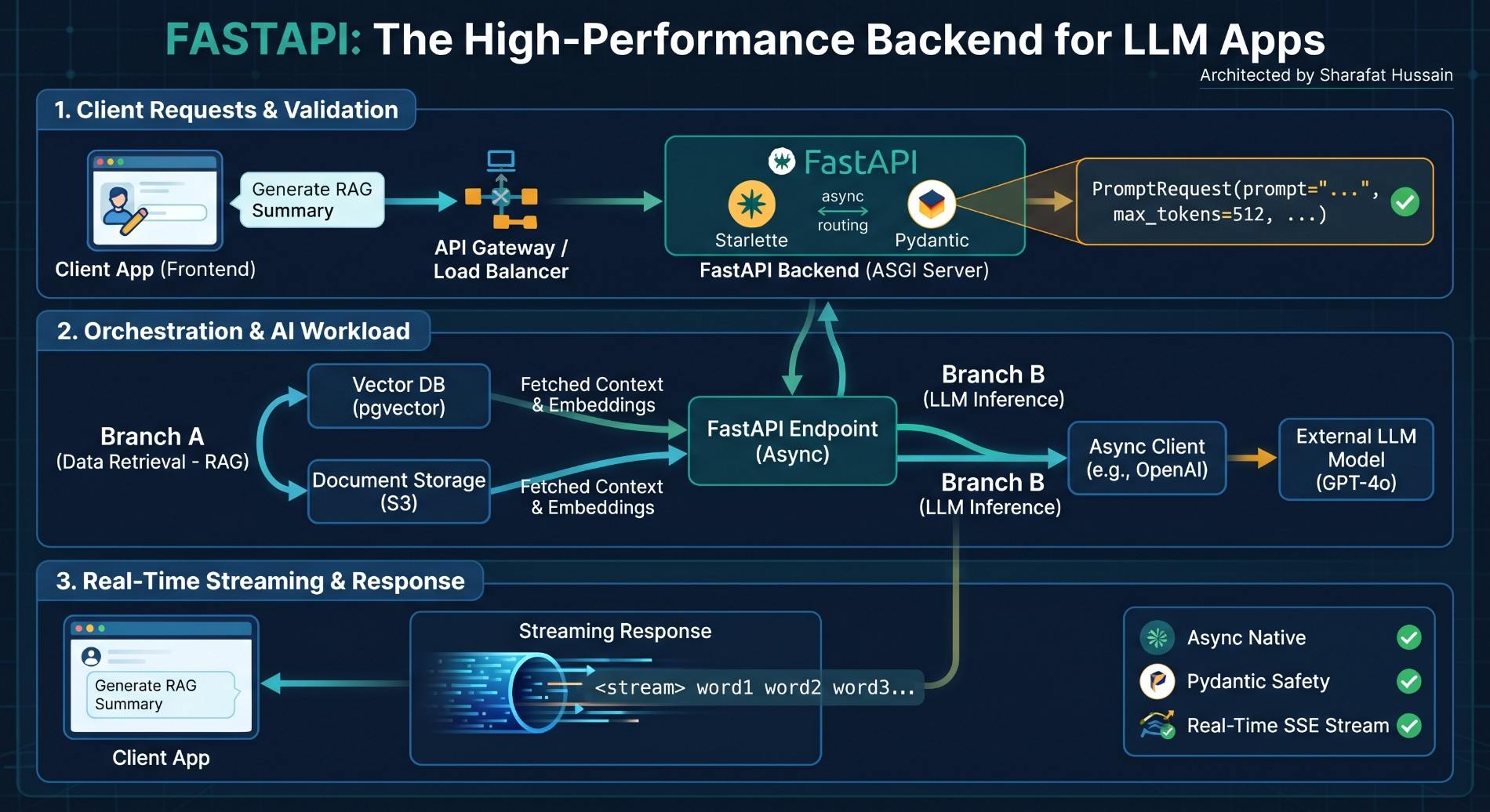
FastAPI is built on top of Starlette for routing and web handling, and Pydantic for data validation. Because it is built on ASGI (Asynchronous Server Gateway Interface), it supports asynchronous programming out of the box. Benchmarks consistently place FastAPI performance on par with NodeJS and Go—an astronomical leap compared to traditional synchronous Python frameworks.
2. Native Support for Server-Sent Events (SSE) and Streaming
When building conversational interfaces, streaming tokens via Server-Sent Events or WebSockets is non-negotiable. FastAPI makes async generators and streaming responses exceptionally clean. You can stream chunks directly from an LLM inference client to your frontend with minimal overhead.
3. Automatic Interactive Documentation (Swagger & Redoc)
APIs handling LLM prompts often involve complex request bodies with dozens of optional hyperparameters (top_p, presence_penalty, stop sequences). FastAPI automatically generates interactive OpenAPI documentation. This allows engineering teams to test endpoints instantly without writing separate Postman collections.
Practical Code Example: Building an Async Streaming LLM Endpoint
To demonstrate why FastAPI for LLM apps is so powerful, let us look at a production-ready code snippet. This example utilizes FastAPI alongside an asynchronous client to stream tokens from an AI model directly to the client interface.
import os
from fastapi import FastAPI, HTTPException
from fastapi.responses import StreamingResponse
from pydantic import BaseModel
import openai

app = FastAPI(
    title="LLM Streaming Backend",
    description="High-performance backend built for production AI agents",
    version="1.0.0"
)

client = openai.AsyncOpenAI(api_key=os.getenv("OPENAI_API_KEY"))

class PromptRequest(BaseModel):
    prompt: str
    system_prompt: str = "You are a helpful AI assistant."
    temperature: float = 0.7
    max_tokens: int = 512

async def generate_llm_stream(req: PromptRequest):
    try:
        response = await client.chat.completions.create(
            model="gpt-4o",
            messages=[
                {"role": "system", "content": req.system_prompt},
                {"role": "user", "content": req.prompt}
            ],
            temperature=req.temperature,
            max_tokens=req.max_tokens,
            stream=True
        )

        async for chunk in response:
            delta = chunk.choices[0].delta.content
            if delta:
                yield delta

    except Exception as e:
        yield f"Error during generation: {str(e)}"

@app.post("/api/v1/generate-stream")
async def stream_endpoint(request_body: PromptRequest):
    if not request_body.prompt.strip():
        raise HTTPException(status_code=400, detail="Prompt cannot be empty.")

    return StreamingResponse(
        generate_llm_stream(request_body),
        media_type="text/event-stream"
    )
This clean, concise structure highlights why FastAPI for LLM apps streamlines development. Type safety via Pydantic ensures malformed requests are rejected instantly before ever hitting your GPU or API provider.
Scaling Beyond APIs: Connecting Agents, Databases, and Vector Stores
In real-world enterprise software, your backend does more than just forward prompts to an LLM. It orchestrates complex Retrieval-Augmented Generation (RAG) pipelines:
- Querying vector databases (like Pinecone, Milvus, or pgvector).
- Running document parsers and OCR tools to ingest PDFs.
- Executing multi-step autonomous agent tool calls.
Because FastAPI is fully asynchronous, your server can query a PostgreSQL database, fetch relevant embeddings from a vector store, and stream the resulting prompt synthesis concurrently. When implementing FastAPI for LLM apps, developers experience zero blocking bottlenecks during heavy database or network operations.
Furthermore, integrating FastAPI for LLM apps with containerization tools like Docker and orchestration platforms like Kubernetes is seamless. You can package your Python environment, ASGI server (like Uvicorn), and machine learning dependencies into lightweight production containers that scale horizontally under heavy enterprise loads.
Comparing FastAPI with Traditional Frameworks
Feature | Django / Django REST | Flask | FastAPI |
Async Native | Partial / Complex | no | Yes (ASGI-native) |
Data Validation | Serializers (Verbose) | Manual / Marshmallow | Pydantic (Automatic & Fast) |
Docs Generation | Third-party packages | Manual | Automatic OpenAPI / Swagger |
Streaming Support | Difficult | Difficult | Native async generators |
Ideal Use Case | Monolithic CRUD apps | Microservices / Prototyping | High-concurrency AI & LLM apps |
As this comparison illustrates, while older frameworks excel at traditional web applications, leveraging FastAPI for LLM apps gives engineering teams a modern, type-safe, and high-performance advantage.
Conclusion
The success of a generative AI product depends heavily on its backend infrastructure. Latency, concurrency handling, robust type validation, and seamless streaming capabilities are the pillars of a great AI user experience.
Throughout my decade-long engineering journey building enterprise software and SaaS systems, I have rarely encountered a tool as developer-friendly and performant as FastAPI. By combining automatic data validation, native asynchronous support, and blistering execution speeds, FastAPI for LLM apps provides the ultimate foundation for modern artificial intelligence architecture.
Whether you are building a custom RAG pipeline, an autonomous agent workflow, or a real-time conversational assistant, adopting FastAPI for LLM apps will future-proof your tech stack and elevate your product to production-grade excellence.